

Understanding Your Path to Affordable Addiction Treatment
Does private health insurance cover rehab? Yes, most private health insurance plans are required by law to cover addiction rehabilitation and substance use disorder treatment. Thanks to the Affordable Care Act (ACA) and the Mental Health Parity and Addiction Equity Act, insurance companies must provide coverage for mental health and addiction services similar to how they cover other medical conditions. However, the extent of coverage varies significantly based on your specific policy, plan type, and the treatment services you need.
Quick Answer: What You Need to Know
- Coverage is mandated by federal law for most private insurance plans
- Different levels of care are typically covered including detox, inpatient, and outpatient programs
- Your out-of-pocket costs depend on deductibles, copayments, and whether providers are in-network
- Pre-authorization is often required before starting treatment
- Verification is essential – always confirm coverage details with your insurance provider before admission
If you’re facing addiction and worried about the cost of treatment, understanding your insurance benefits is crucial. Many people find they have more coverage than expected, but the process of verifying benefits can feel overwhelming when you’re already struggling.
According to recent data, as of 2021, 90% of American adults with health insurance had coverage for mental health and substance use disorder treatment. The challenge isn’t whether coverage exists – it’s understanding what your specific policy covers and how to access those benefits.
This guide will walk you through everything you need to know about using your private health insurance for rehab. We’ll explain the legal protections that guarantee your coverage, the types of treatment typically covered, and most importantly, the exact steps to verify your benefits and understand your financial responsibility.
You don’t have to steer this alone. Treatment centers like Pine Meadows Recovery routinely work with insurance providers to help verify coverage and minimize out-of-pocket costs for patients seeking help.
The Legal Foundation for Rehab Coverage
It wasn’t always this way. For many years, addiction was often viewed as a moral failing rather than a medical condition, leading to limited or no insurance coverage for treatment. Thankfully, significant legislative changes have transformed how private health insurance approaches addiction rehabilitation. These laws ensure that for most Americans, the question, “does private health insurance cover rehab?” can be answered with a resounding “yes!”
The most impactful of these changes are the Affordable Care Act (ACA) and the Mental Health Parity and Addiction Equity Act (MHPAEA).
The Affordable Care Act (ACA), signed into law in 2010, made health insurance more accessible and affordable for millions of Americans. A cornerstone of the ACA is its mandate that all Marketplace plans, and most other private plans, cover “Essential Health Benefits.” Crucially, these benefits include mental health services and substance use disorder treatment. This means that insurance companies cannot deny you access to these vital services. Furthermore, the ACA prohibits insurance companies from denying coverage based on pre-existing conditions, which historically created a significant barrier for individuals seeking addiction treatment. We encourage you to learn more about your rights regarding mental health & substance abuse coverage under the ACA.
Building on previous legislation, the Mental Health Parity and Addiction Equity Act (MHPAEA) of 2008 prevents insurance plans from imposing more restrictive financial requirements or treatment limitations on mental health and substance use disorder benefits than they do on medical or surgical benefits. This “parity” means that your plan can’t charge you higher deductibles or copayments for addiction treatment than for, say, a broken arm. It also applies to crucial aspects like “medical necessity” criteria, prior authorization requirements, and utilization review processes. The goal is to ensure that mental health and substance use disorders are treated with the same priority as physical health concerns. The American Psychological Association provides further insights into these parity laws.
Thanks to these federal mandates, employer-sponsored group health plans and plans sold on the ACA exchanges are largely required to provide comparable coverage. This legal framework has been instrumental in increasing access to addiction treatment and ensuring that finances are less of a barrier to recovery.
What Levels of Addiction Treatment Can Insurance Cover?
Addiction treatment is not a one-size-fits-all solution; it’s a dynamic process that often involves a “continuum of care.” This means that as your needs evolve during recovery, you might transition between different levels of support. Most private health insurance plans are designed to cover various stages of this continuum, guided by the American Society of Addiction Medicine (ASAM) criteria. These criteria help determine the most appropriate level of care based on an individual’s specific needs, ensuring that treatment is both effective and medically necessary.

At Pine Meadows Recovery, we offer a range of evidence-based programs in Kenosha, Wisconsin, that align with these widely recognized levels of care, and which your insurance may cover.
Medical Detoxification
The first critical step for many on the path to recovery is medical detoxification. This is a process where individuals safely and comfortably withdraw from substances under continuous medical supervision. Depending on the substance used, withdrawal can be dangerous and extremely uncomfortable, sometimes requiring medication to manage symptoms. Insurance typically recognizes medical detox as an essential first step in addiction treatment. We provide comprehensive Detoxification services, focusing on stabilizing your physical health and preparing you for the therapeutic work ahead. Coverage for detox can vary based on factors like the need for medication, the setting (inpatient vs. outpatient), and the duration.
Inpatient and Residential Programs
For those requiring a highly structured and supportive environment, inpatient and residential addiction treatment programs offer 24/7 care. In these settings, clients live and sleep onsite, fully immersing themselves in the recovery process away from external triggers and stressors. This level of care is often recommended for individuals with severe addictions, those with co-occurring mental health disorders, or those who lack a stable home environment. Our programs provide a safe, therapeutic community where clients can focus solely on healing.
Outpatient Programs (PHP, IOP, OP)
As individuals progress in their recovery, or for those with less severe addictions and strong support systems at home, outpatient programs offer a flexible alternative. These programs allow clients to live at home while attending scheduled therapy sessions and groups. There are different intensities of outpatient care:
- Partial Hospitalization Programs (PHP): Often referred to as “day treatment,” Partial Hospitalization (PHP) provides intensive, structured therapy for several hours a day, multiple days a week, acting as a bridge between inpatient care and less intensive outpatient options.
- Intensive Outpatient Programs (IOP): These programs offer fewer hours per week than PHP but still provide significant therapeutic support, allowing for more flexibility to manage work, school, or family responsibilities. Our Intensive Outpatient Program is designed to support individuals in maintaining their daily lives while building recovery skills.
- Standard Outpatient Programs (OP): This is the least intensive level of care, typically involving one or two therapy sessions per week. It’s ideal for ongoing support and relapse prevention. Our Outpatient Program focuses on integrating recovery into everyday life.
Co-Occurring Disorders and Mental Health
It’s common for individuals struggling with addiction to also experience co-occurring mental health disorders, such as anxiety or depression. This is often referred to as a Dual Diagnosis. The good news is that thanks to federal parity laws, private health insurance generally covers treatment for these mental health conditions alongside addiction. Our holistic approach at Pine Meadows Recovery ensures that both the substance use disorder and any underlying Mental Health issues are addressed concurrently, providing integrated care for a more comprehensive and sustainable recovery.
Your Step-by-Step Guide: How to Verify if Private Health Insurance Covers Rehab
Understanding that does private health insurance cover rehab? is just the first step. The next is navigating the specifics of your policy. While the process can seem daunting, especially when you’re already under stress, we’re here to help simplify it. Verifying your coverage involves understanding terms like “pre-authorization” and “medical necessity,” and a bit of detective work on your part. But don’t worry, we’ll guide you through it.

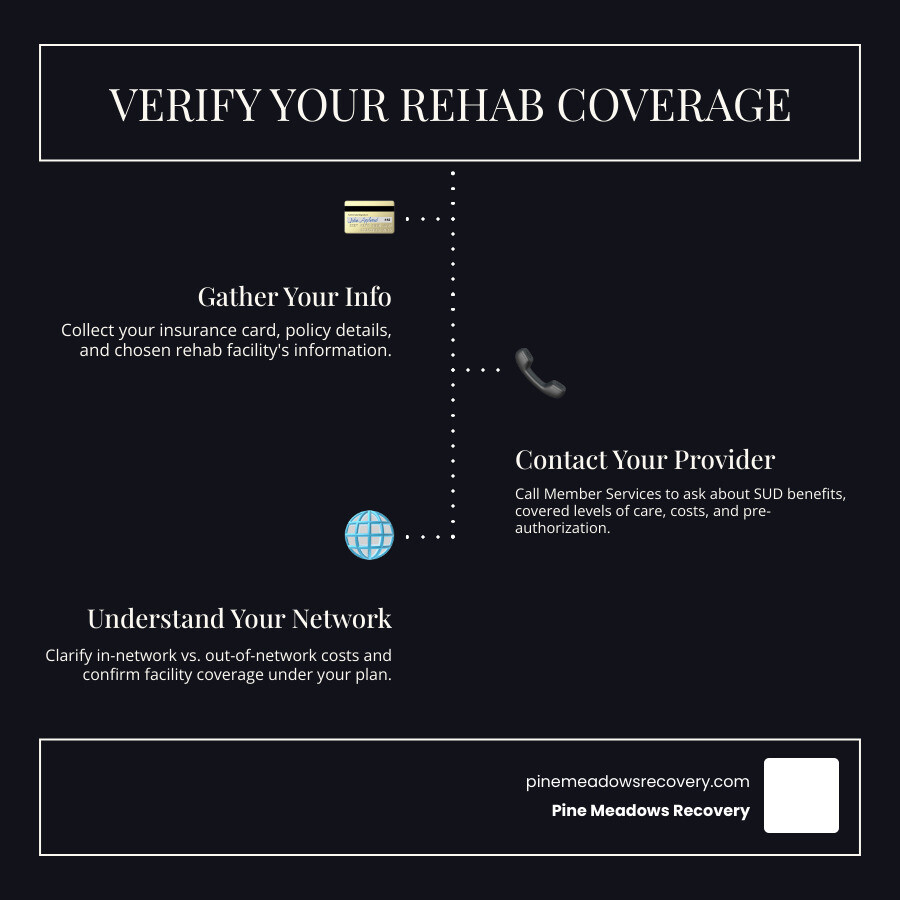
1. Gather Your Information
Before you contact anyone, have your essential documents ready. This will make the conversation smoother and ensure you get accurate information. You’ll need:
- Your insurance card (front and back)
- Your policy number and Member ID
- Your group number (if applicable)
- The name, address, and contact information of the rehab facility you are considering (e.g., Pine Meadows Recovery, Kenosha, Wisconsin)
- Any potential diagnosis or referral information you have from a doctor, as this may be required for “medical necessity” determinations.
2. Contact Your Insurance Provider Directly
This is arguably the most crucial step. Call the “Member Services” or “Behavioral Health” number located on the back of your insurance card. Be prepared to take detailed notes during your conversation, including the date, time, and the name of the representative you speak with.
Here’s a list of key questions to ask your insurance provider:
- What are my benefits for substance use disorder treatment? Be specific about the type of addiction (e.g., alcohol, opioids).
- What levels of care are covered (detox, inpatient, residential, partial hospitalization, intensive outpatient, standard outpatient)? Ask about the percentage of costs covered for each.
- What is my deductible, copayment, and out-of-pocket maximum for addiction treatment? This will help you understand your financial responsibility.
- Do I need a pre-authorization or referral for treatment? If so, what is the process, and how long does it typically take?
- Is Pine Meadows Recovery (or your chosen facility) in-network or out-of-network? The answer to this question significantly impacts your costs.
- What is the typical duration of treatment covered? Insurance often authorizes treatment in increments (e.g., a few days or weeks at a time), requiring clinical updates for extensions.
- What criteria does the insurance company use to determine “medical necessity” for addiction treatment? Understanding this can help prevent denials.
You are your best advocate. Don’t hesitate to ask for clarification if anything is unclear.
3. Understand In-Network vs. Out-of-Network
One of the biggest factors influencing your out-of-pocket costs is whether the treatment provider is “in-network” or “out-of-network” with your insurance plan.
- In-Network Providers: These are facilities or professionals who have a contract with your insurance company. They’ve agreed to provide services at a negotiated rate, which generally results in lower costs for you. Your insurance will typically cover a larger percentage of the bill, and your deductible and copayments will be lower.
- Out-of-Network Providers: These facilities do not have a contract with your insurance company. While your plan might still offer some coverage, it’s usually at a lower percentage, meaning you’ll pay a higher portion of the cost. You might also have a separate, higher deductible for out-of-network care.
Understanding your plan type is key here. Health insurance plan & network types: HMOs, PPOs, and more explains the differences:
- HMO (Health Maintenance Organization) plans often have lower monthly premiums but limit coverage to doctors and facilities within the plan’s network. You’ll typically need a referral from a primary care physician to see a specialist or get certain treatments.
- PPO (Preferred Provider Organization) plans offer more flexibility, allowing you to see out-of-network providers without a referral, though usually at a higher cost. This flexibility can be beneficial if your preferred rehab facility is out-of-network.
Always confirm the in-network status of your desired treatment center directly with your insurance provider and the facility itself.
Understanding Your Financial Responsibility and Options
Navigating addiction treatment can feel like a financial maze, but with a clear understanding of your insurance benefits and potential out-of-pocket costs, you can plan effectively. Our goal at Pine Meadows Recovery is to ensure you receive the care you need without being overwhelmed by unexpected bills.
Common Out-of-Pocket Costs
Even with robust insurance coverage, you’ll likely have some financial responsibility. These common terms will help you understand what to expect:
- Deductible: This is the amount you must pay out of pocket for covered healthcare services before your insurance plan starts to pay. For example, if your deductible is $2,000, you pay the first $2,000 of covered services yourself.
- Copayment (Copay): A fixed amount you pay for a covered health service after you’ve paid your deductible. For instance, you might pay a $50 copay for each therapy session.
- Coinsurance: Your share of the costs of a covered healthcare service, calculated as a percentage (e.g., 20%) of the allowed amount for the service. You pay coinsurance after you’ve met your deductible. So, if your insurance covers 80% of a $1,000 service after your deductible, you’d pay $200 (20%).
- Out-of-Pocket Maximum: This is the most you’ll have to pay for covered services in a policy year. Once you reach this limit, your insurance plan pays 100% of the cost of covered benefits for the rest of the year. Understanding this figure is crucial for budgeting.
- Gap Payments: Sometimes, there might be a “gap” between what your provider charges and what your insurance covers, even for in-network services. This can result from services not fully covered, or from differences in negotiated rates.
What factors influence if private health insurance covers rehab?
The extent to which does private health insurance cover rehab is a nuanced question, influenced by several factors:
- Type of Plan: As discussed, HMOs and PPOs have different structures regarding networks and referrals, which directly impacts coverage and costs.
- State Regulations: While federal laws like the ACA and MHPAEA set a baseline, individual states can have their own mandates that further expand coverage for addiction treatment. Always consider any specific regulations in Wisconsin that might apply.
- Medical Necessity Determination: Insurance companies will assess whether the recommended treatment is “medically necessary.” This is often based on ASAM criteria, evaluating the severity of the addiction, co-occurring mental health conditions, prior treatment history, and the individual’s overall health.
- Length of Stay: Insurance typically covers treatment in increments (e.g., a few days or weeks at a time). Continued coverage depends on ongoing assessments by the clinical team demonstrating progress and continued medical necessity. Some policies might cover 30, 60, or 90 days, but extensions require regular reviews.
- Specific Services Used: While evidence-based therapies like individual and group counseling, CBT, and medication-assisted treatment (MAT) are generally covered, more holistic or alternative therapies might not be. Coverage for detox can also vary based on whether medication is needed and the setting.
- Severity of Addiction and Co-occurring Disorders: More severe addictions or the presence of complex dual diagnoses often warrant higher levels of care (like inpatient), which insurance is more likely to cover extensively due to increased medical necessity.
What to do if your private health insurance does not cover rehab?
If, after all your research, you find that your private health insurance doesn’t cover the rehab you need, or only covers a small portion, don’t lose hope. There are still many avenues to explore:
- State-Funded Rehab Options: Many states, including Wisconsin, offer state-funded rehab options for individuals who lack insurance or have limited financial resources. These programs are often free or low-cost and are supported by government funding.
- Sliding Scale Fees: Some treatment centers offer a sliding scale fee structure, where the cost of treatment is adjusted based on your income and ability to pay. Don’t be afraid to ask facilities about this option.
- Payment Plans: Many rehab facilities are willing to work with you to set up manageable payment plans, allowing you to pay for treatment in installments over time.
- Scholarships or Grants: Non-profit organizations and some treatment centers offer scholarships or grants specifically for addiction treatment. It’s worth researching these opportunities, as they can significantly reduce the financial burden.
- Healthcare Loans: Specialized healthcare loans are available through various lenders, designed to help cover medical expenses, including addiction treatment.
- Community Support Groups: Organizations like Alcoholics Anonymous (AA) and Narcotics Anonymous (NA) are free to attend and provide invaluable peer support. While not a substitute for clinical treatment, they can be a critical part of a recovery journey and some may offer financial guidance or assistance.
The cost of addiction often far outweighs the cost of treatment. We believe everyone deserves access to life-saving care.
Frequently Asked Questions About Rehab Insurance
Which major private insurance providers offer coverage for addiction rehab?
Many leading private insurance providers in the U.S. offer coverage for addiction rehabilitation, thanks to federal mandates. While specific plans and their benefits vary, you’ll typically find coverage from major players such as:
- Aetna
- Cigna
- Blue Cross Blue Shield (including Anthem Blue Cross, which operates in many states)
- United Healthcare
- Humana
- Guide Health Options
- ComPsych
- First Health Network
- Health Net
- Magellan Health
- MHN
- MultiPlan
It’s crucial to remember that while these providers generally offer coverage, the specifics (deductibles, copays, in-network vs. out-of-network, levels of care covered) depend entirely on your individual policy. Always verify your specific benefits directly with your insurance provider.
What is the typical duration of treatment covered by private insurance?
The duration of treatment covered by private insurance for rehab is highly variable and depends on your specific plan and the medical necessity of your care.
- Common Durations: Many plans will cover initial stays of 30, 60, or 90 days for inpatient or residential treatment.
- Authorization in Increments: Insurance companies often authorize coverage in shorter increments, such as a few days or weeks at a time. They then require regular clinical updates and patient assessments from the treatment facility to approve extensions. This process ensures that treatment remains medically necessary and effective.
- Clinical Progress: The decision to extend coverage is heavily influenced by your clinical progress and the recommendations of your treatment team. If you’re showing improvement and continued need for care, coverage is more likely to be extended.
- Outpatient Care: Outpatient programs (PHP, IOP, OP) can be covered for longer periods, often for several months, as they are typically a step-down from more intensive care and focus on long-term recovery and relapse prevention.
Always inquire about the typical duration of coverage when you speak with your insurance provider and the admissions team at the rehab facility.
Can private insurance deny coverage for rehab?
While federal laws mandate coverage for addiction treatment, private insurance companies can, and sometimes do, deny coverage for specific services or extended stays. However, you have rights and options if this happens:
- Reasons for Denial: Common reasons for denial include:
- Lack of Medical Necessity: The insurance company may argue that the treatment level or duration is not medically necessary based on their criteria.
- Pre-authorization Issues: Failure to obtain pre-authorization before starting treatment can lead to denial.
- Out-of-Network Services: If you seek treatment from an out-of-network provider, especially with an HMO plan, coverage may be denied or significantly reduced.
- Administrative Errors: Sometimes, denials are simply due to paperwork errors or incomplete information.
- Appeal Process: If your coverage is denied, you have the right to appeal the decision. Your Explanation of Benefits (EOB) will outline the steps for appealing. This typically involves submitting a written appeal with supporting documentation from your treatment team, demonstrating the medical necessity of the care.
- Advocacy: Don’t give up! We recommend working closely with the admissions and billing team at your chosen rehab facility. They often have experience navigating these appeals and can advocate on your behalf. You can also contact your state’s Department of Insurance or consumer protection agencies for assistance.
Understanding these possibilities upfront and being prepared to advocate for your care is crucial.
Take the First Step Towards Recovery
We hope this guide has demystified the question, “does private health insurance cover rehab?” The answer, for most, is a hopeful yes, but it requires proactive verification and understanding of your specific policy. The journey to recovery is profound and life-changing, and financial concerns shouldn’t stand in your way.
At Pine Meadows Recovery in Kenosha, Wisconsin, we are dedicated to providing compassionate, evidence-based, and personalized treatment for substance abuse and co-occurring disorders. We understand the complexities of insurance and are here to help you steer the process. Our team regularly works with major private insurance providers to verify benefits and streamline your admission, allowing you to focus on what truly matters: your healing.
Don’t let uncertainty about insurance coverage delay your path to a healthier, happier life. Healing is possible, and we are ready to support you every step of the way.
Verify your insurance coverage with us today to take the first confident step towards recovery.