
What Insurance Covers Rehab in Wisconsin — And How to Access It
What insurance covers rehab in Wisconsin is one of the most important questions you can ask before starting treatment. Here’s the short answer:
Most major insurance types cover addiction rehab in Wisconsin, including:
- Private insurance (Anthem BCBS, Cigna, UMR, Network Health, and others)
- Wisconsin Medicaid / BadgerCare Plus — covers over 1.2 million residents
- ACA Marketplace plans — all plans must cover substance use disorder treatment as an essential health benefit
- Medicare — covers certain rehab services depending on the plan
- Employer-sponsored plans — coverage varies by employer and plan design
- VA insurance — for eligible veterans and military families
Federal law requires that ACA-compliant plans cover substance use disorder treatment. They cannot deny you coverage for a pre-existing addiction, and they cannot place yearly or lifetime dollar limits on those benefits.
At Pine Meadows Recovery in Kenosha, Wisconsin, we work with individuals every day who are navigating exactly this question — helping them understand what their insurance covers and connecting them with the right level of care. Our experience guiding clients through insurance verification for rehab in Wisconsin means you don’t have to figure this out alone.
The sections below break down everything you need to know — from Medicaid eligibility to private payers to your legal rights if coverage is denied.
Types of Insurance That Cover Rehab in Wisconsin
Navigating healthcare can feel like learning a new language, especially when you are already dealing with the stress of addiction. However, as of April 2026, the landscape for coverage is more robust than ever. Under the Affordable Care Act (ACA), substance use disorder (SUD) treatment is classified as an “essential health benefit.” This means that almost all health plans—whether you bought them on the Marketplace or received them through an employer—must provide coverage for behavioral health and addiction services.
One of the most significant protections provided by federal law is the rule regarding pre-existing conditions. In the past, insurance companies could deny coverage if you had a history of substance use. Today, that is illegal. Your coverage begins the day your plan starts, and insurers cannot charge you more just because you need help with a substance use disorder.
If you aren’t sure where to start, you can verify your insurance coverage for Wisconsin rehab through our secure portal. We can help you determine which addiction treatment services are specifically included in your policy.
Comparison of Wisconsin Insurance Benefits
| Feature | Private Insurance (PPO/HMO) | Wisconsin Medicaid (BadgerCare Plus) | ACA Marketplace Plans |
|---|---|---|---|
| Network | Specific list of providers | Broad network of state-approved centers | Varies by plan (Bronze/Silver/Gold) |
| Costs | Deductibles and copays apply | Generally no copays for SUD services | Subsidies available; parity rules apply |
| Residential | Often covered (clinical fees) | Covered (clinical only; no room/board) | Essential health benefit |
| Outpatient | Broadly covered | Broadly covered | Broadly covered |
Anthem Blue Cross Blue Shield and Private Payers
Anthem Blue Cross Blue Shield (BCBS) is one of the most prominent private insurers in Wisconsin. They provide benefits to a significant portion of the population, including over 66% of federal employees and retirees under the Federal Employees Health Benefits Program (FEHBP).
When looking at What Insurance Covers Rehab in Wisconsin, private payers like Anthem typically offer tiered plans:
- Bronze: Covers about 60% of medical costs.
- Silver: Covers about 70% of medical costs.
- Gold: Covers about 80% of medical costs.
Depending on whether you have a PPO (Preferred Provider Organization) or an HMO (Health Maintenance Organization), your out-of-pocket costs will vary. PPOs often give you the flexibility to see out-of-network providers, though staying in-network will always be the most cost-effective choice. Many people find that intensive outpatient programs are a great way to utilize these benefits while maintaining their daily work or family commitments.
Wisconsin Medicaid (BadgerCare Plus) and Public Coverage
Wisconsin Medicaid, often referred to as BadgerCare Plus, is a vital resource for over 1.2 million residents. This program is designed for low-income individuals, families with children, pregnant women, and people with disabilities. Since the expansion of BadgerCare Plus in 1999, income limits have become more inclusive, allowing residents up to 200% of the Federal Poverty Level (FPL) to access care in some categories.
For more detailed information on state-specific resources, you can visit the Substance Use: Care and Coverage | Wisconsin Department of Health Services website. Wisconsin operates a state-supervised, county-administered system, meaning each of the 72 counties plays a role in delivering or overseeing public substance use services. Tribal programs also offer specialized, culturally relevant care for Indigenous residents across the state.
Understanding What Insurance Covers Rehab in Wisconsin Services
Insurance doesn’t just cover “rehab” as a single block; it covers a continuum of care. Most plans are designed to support you from the moment you decide to stop using until you are firmly established in long-term recovery.
- Medical Detox: This is often the first step. Insurance typically covers medically supervised detoxification to ensure you can safely manage withdrawal symptoms.
- Inpatient Rehab: This involves living at a facility 24/7. While insurance covers the medical and therapeutic components, there are specific rules about the “hotel” side of the stay (room and board).
- Outpatient Care: This includes partial hospitalization (PHP) and intensive outpatient programs (IOP). These are highly effective for those who need structure but can return home at night.
- Medication-Assisted Treatment (MAT): Medications like buprenorphine or naltrexone are often covered as part of a comprehensive recovery plan for opioid or alcohol use disorders.
- Dual Diagnosis: Many people struggling with addiction also face mental health challenges like depression or anxiety. Insurance is required to cover treatment for both simultaneously.

Residential Treatment and Room and Board Costs
A common point of confusion regarding What Insurance Covers Rehab in Wisconsin is the distinction between clinical services and room and board. In a residential setting, “clinical services” include therapy, medical monitoring, and nursing care. These are almost always covered by insurance.
However, “room and board”—the cost of your bed, meals, and the facility’s utilities—is treated differently. Wisconsin Medicaid, for example, covers the treatment services within a residential facility but does not cover room and board. In these cases, residents may need to look into county-funded grants or sliding scale fees to cover the non-clinical portion of the stay. Understanding the cost of rehab in Wisconsin requires looking at your plan’s specific “transitional treatment” definitions, which are services certified by the DHS that bridge the gap between inpatient and outpatient care.
Quality Indicators for Insurance-Approved Programs
When choosing a facility that accepts your insurance, you want to ensure you are receiving high-quality care. The Wisconsin Department of Health Services points to five major signs of quality:
- Accreditation: Look for facilities accredited by the Joint Commission or CARF (Commission on Accreditation of Rehabilitation Facilities). These organizations set rigorous standards for safety and effectiveness.
- Evidence-Based Practices: The program should use proven methods like Cognitive Behavioral Therapy (CBT) or Motivational Interviewing.
- FDA-Approved Medications: Quality programs offer MAT options for those who need them.
- Family Involvement: Recovery is more successful when the family is educated and involved in the process.
- Ongoing Supports: Quality care doesn’t end at discharge. It should include aftercare planning, sober housing referrals, or peer support.
At Pine Meadows Recovery, our commitment to quality care means we integrate all these indicators into our personalized programs.
Parity Laws and Your Rights to Addiction Treatment
You have legal protections that ensure you aren’t treated unfairly by your insurance company. The Mental Health Parity and Addiction Equity Act (MHPAEA) is a federal law that requires insurance companies to treat mental health and substance use benefits the same way they treat medical and surgical benefits.
In Wisconsin, state law (s. 632.89) further reinforces these protections. This means:
- Financial Limits: Your copays and deductibles for rehab cannot be higher than they are for a visit to a primary care doctor or a hospital stay for a physical illness.
- Treatment Limits: Insurers cannot place arbitrary limits on the number of days you stay in rehab if those same limits aren’t applied to other medical conditions.
- Care Management: Prior authorization requirements must be based on “medical necessity” and cannot be more restrictive for addiction than for other health issues.
If you want to dive deeper into these regulations, the OCI Fact Sheet on the Treatment of Opioid Addiction & Other Substance Use Disorders provides a comprehensive overview. If you feel your insurance has unfairly denied coverage, you have the right to appeal and can even file a complaint with the Wisconsin Office of the Commissioner of Insurance (OCI).

How to Verify What Insurance Covers Rehab in Wisconsin
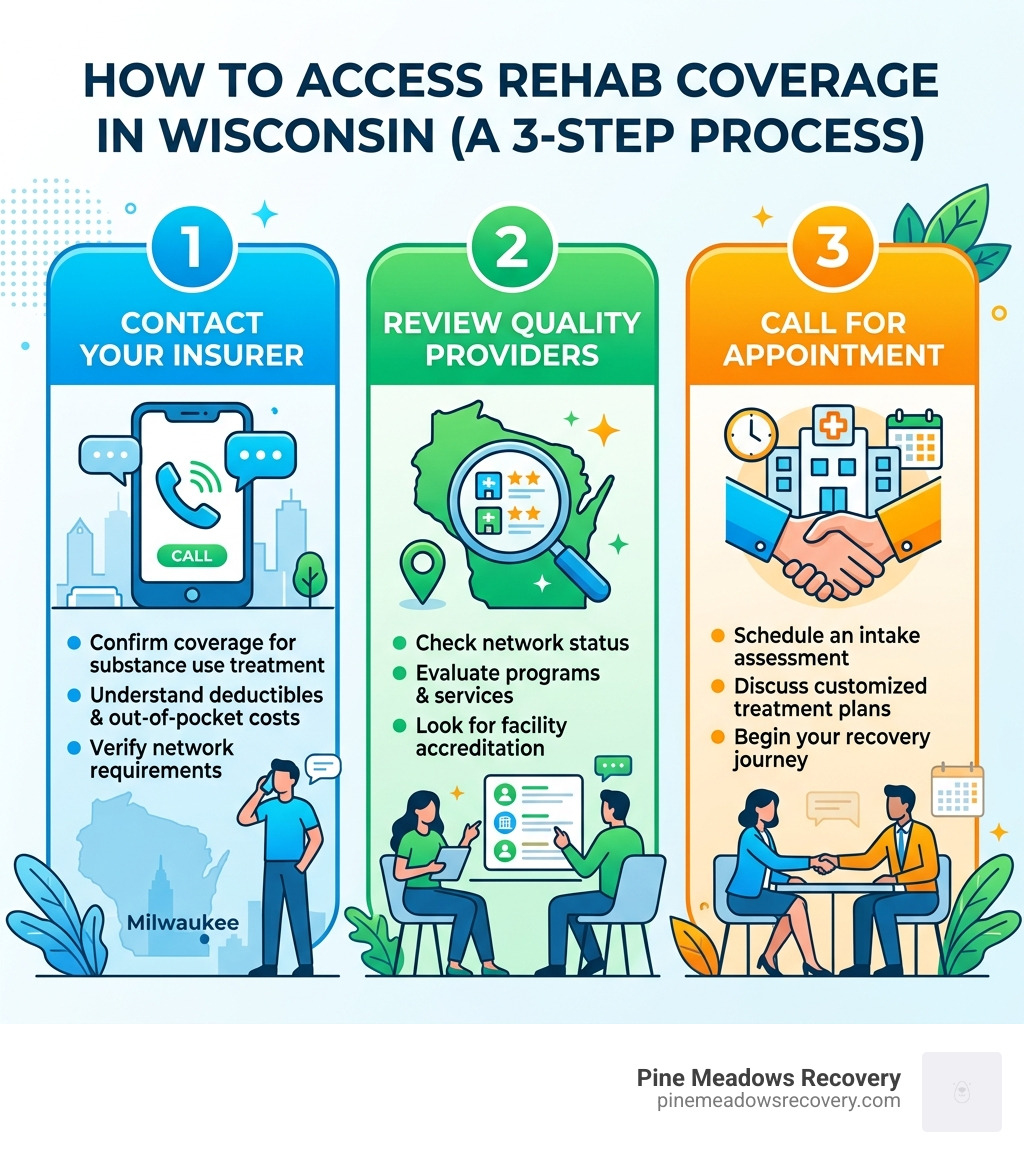
Before you pack your bags for rehab, there are a few practical steps you should take to ensure your costs are covered.
- Contact Your Insurer: Call the number on the back of your card. Ask specifically about “behavioral health” or “substance use disorder” benefits.
- Confirm In-Network Status: Ask for a list of preferred providers in the Kenosha area or wherever you plan to seek treatment.
- Ask About Prior Authorization: Many plans require the facility to get “pre-approval” before you are admitted.
- Determine Medical Necessity: Your doctor or the rehab facility’s intake team will provide an assessment to show the insurance company why a specific level of care (like inpatient or outpatient programs) is necessary.
It is also important to know that Wisconsin providers must follow “admission priorities.” Pregnant women who inject drugs are given the highest priority for admission, followed by other pregnant women, other injecting drug users, and then the general population.
Frequently Asked Questions about Wisconsin Rehab Insurance
Does Wisconsin Medicaid cover residential rehab?
Yes, Wisconsin Medicaid (BadgerCare Plus) covers the clinical portion of residential rehab. This includes assessment, treatment planning, individual and group counseling, and medication management. However, it typically does not cover the cost of room and board. You can find a list of state-approved facilities through the Wisconsin DHS Substance Use Services Directory.
What are the out-of-pocket costs for rehab in Wisconsin?
Out-of-pocket costs depend entirely on your specific plan. You may be responsible for a deductible (the amount you pay before insurance kicks in), copays (a flat fee per visit), or coinsurance (a percentage of the total cost). Most plans have an “out-of-pocket maximum,” which is the most you will have to pay in a single year. For those without insurance, many Wisconsin facilities offer sliding scale fees based on income.
How do I find a rehab center that accepts my insurance?
The best way to find an accepting center is to use your insurance company’s online provider directory or call the Wisconsin Addiction Recovery Helpline. If you are looking for care in Kenosha, you can also contact Pine Meadows Recovery for insurance assistance. We can run a free, confidential check to tell you exactly what your plan will cover at our facility.
Conclusion
Understanding What Insurance Covers Rehab in Wisconsin is the first step toward a new life. Whether you are covered by BadgerCare Plus, a private Anthem plan, or a Marketplace policy, the law is on your side to ensure you get the help you need. Recovery isn’t just about stopping drug or alcohol use; it’s about healing the whole person—mind, body, and spirit.
At Pine Meadows Recovery in Kenosha, we take a holistic and personalized approach to every client we serve. We believe that financial concerns should never be a barrier to healing. If you or a loved one is ready to take that first step, we are here to help you navigate the paperwork so you can focus on what really matters: your health and your future.
Start your recovery journey today—reach out to us to learn more about our programs and how we can make treatment work for you.