
Why Mental Health Support Groups in Kenosha, WI Matter for Your Recovery
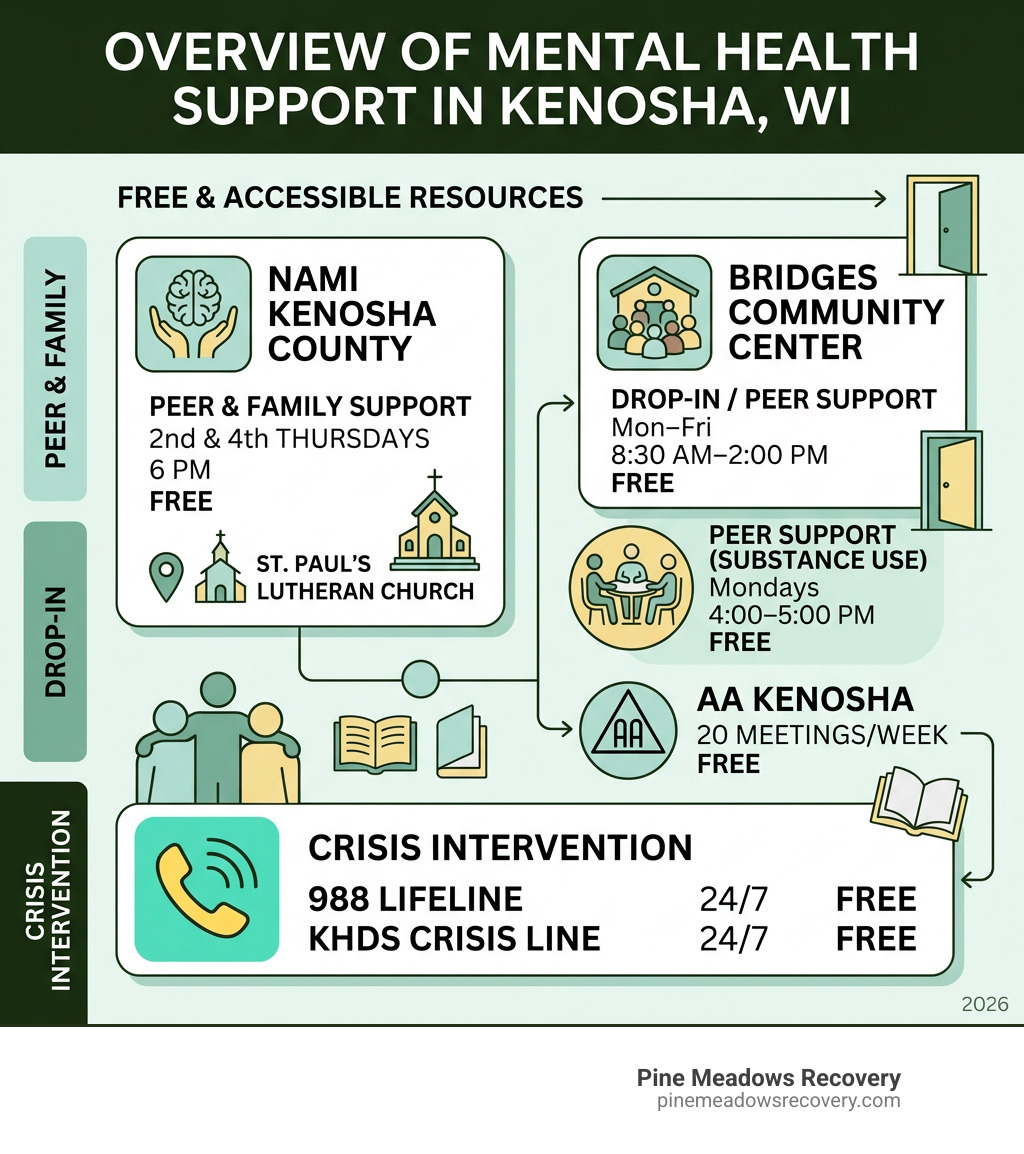
Mental health support groups in Kenosha WI are free, accessible, and available right now — no referral needed. Here’s a quick overview of your main options:
| Resource | Type | Schedule | Cost |
|---|---|---|---|
| NAMI Kenosha County | Peer & Family Support | 2nd & 4th Thursdays, 6 PM | Free |
| Bridges Community Center | Drop-in / Peer Support | Mon–Fri, 8:30 AM–2:00 PM | Free |
| Peer Support (Substance Use) | Peer-led Group | Mondays, 4:00–5:00 PM | Free |
| AA Kenosha | Alcohol Recovery | 20 meetings/week | Free |
| 988 Lifeline / KHDS Crisis Line | Crisis Intervention | 24/7 | Free |
Dealing with addiction or a mental health crisis can feel completely isolating. But you don’t have to figure it out alone. Kenosha has a real network of peer-led groups, drop-in centers, and crisis resources — many of them completely free — built specifically for people going through what you’re going through.
Whether you’re struggling with anxiety, depression, PTSD, bipolar disorder, or a substance use disorder, there’s a group in Kenosha designed to meet you where you are.
At Pine Meadows Recovery, we’re an addiction treatment center based right in Kenosha, WI, with direct experience helping people connect with the full range of mental health support groups in Kenosha WI alongside our own evidence-based treatment programs. We’ve put together this guide so you can find the right support — fast.
Finding Mental Health Support Groups in Kenosha WI
When we talk about finding a community that truly “gets it,” NAMI Kenosha County is often the first place we point people toward. NAMI, which stands for the National Alliance on Mental Illness, is the nation’s largest grassroots mental health organization, and our local Kenosha affiliate is incredibly active.
They operate out of St. Paul’s Lutheran Church, providing a safe haven for those navigating the complexities of mental health conditions. These aren’t clinical therapy sessions led by doctors in white coats; they are peer-led sessions. This means the people leading the group have walked in your shoes. They understand the weight of a diagnosis and the hurdles of recovery because they’ve cleared them too.
In addition to peer support, NAMI recognizes that mental illness affects the whole family. That is why they offer dedicated family support groups. If you are a parent, spouse, or friend of someone struggling, these groups provide a space to share frustrations, learn coping strategies, and realize you aren’t the only one feeling overwhelmed. For a broader look at professional options in the area, you can also check out this Mental Health Clinics Kenosha WI Guide.
NAMI Mental Health Support Groups in Kenosha WI Schedules
Timing is everything when you’re looking for help. NAMI Kenosha County holds its bimonthly support groups on the second and fourth Thursdays of each month. These meetings start promptly at 6:00 PM and typically run until 7:30 PM.
The meetings are split into two distinct sections:
- Adult Peer Support (NAMI Connection): For adults living with a mental health condition.
- Family & Friends Group: For the loved ones of those living with a mental health condition.
NAMI Kenosha actually offers 19 different programs in total. Some of the most impactful include NAMI Connection, a recovery support group for adults living with mental illness, and NAMI Family-to-Family, an educational course for families. They also offer “In Our Own Voice” presentations and “Peer-to-Peer” experiential learning.
If you have questions about which group is right for you, you can reach out to them directly at [email protected] or call 262-652-3606. Their mailing address is PO Box 631, Kenosha, WI 53141.
Accessing Free Mental Health Support Groups in Kenosha WI
One of the biggest barriers to care is cost. Fortunately, many of the most effective mental health support groups in Kenosha WI are no-cost resources. We believe that financial status should never dictate your ability to heal.
A cornerstone of free support in our city is the Bridges Community Center. This is a “drop-in” center, which means you don’t need an appointment or a fancy referral from a doctor. It’s a place designed for adults recovering from mental illness or substance use disorders to find community and build social skills in a relaxed environment.
At Bridges, the focus is on peer advocacy. You’ll find people who empower one another to take charge of their own recovery. Whether you need help navigating local services or just a place to have a cup of coffee with people who understand your journey, Bridges is there. For more advice on navigating the local system, take a look at these 5 No-Nonsense Tips for Mental Health Services Kenosha County.
Specialized Peer Support and Drop-In Centers
Sometimes, you don’t need a formal meeting; you just need a place to go. The Bridges Community Center, located at 5718 7th Avenue, serves exactly that purpose. They are open Monday through Friday from 8:30 AM to 2:00 PM.
One of the best things about Bridges is that they offer unlimited seating for their groups. You never have to worry about being turned away because a room is too full. The atmosphere is built on:
- Recovery: Focusing on what you can do, not just your symptoms.
- Empowerment: Giving you the tools to speak up for your needs.
- Peer Support: Connecting with others who share similar life experiences.
While clinical therapy is vital for many, peer support offers something different. Here is a quick breakdown of how they compare:
| Feature | Peer Support Groups | Clinical Group Therapy |
|---|---|---|
| Leader | Person with lived experience (Peer) | Licensed Therapist or Counselor |
| Goal | Shared support and coping | Treatment of specific symptoms |
| Cost | Usually Free | Often requires insurance or fee |
| Structure | Informal and flexible | Structured and curriculum-based |
| Focus | Community and connection | Clinical progress and diagnosis |
Support for Specific Conditions and Substance Use
We know that mental health isn’t “one size fits all.” Different conditions require different types of understanding. NAMI Kenosha groups provide support for a wide range of diagnoses, including:
- ADHD and Autism
- Anxiety and OCD
- Bipolar Disorder
- Depression and Eating Disorders
- PTSD and Schizophrenia
If you are specifically looking for Anxiety Treatment Kenosha County, joining a peer group can be a powerful supplement to your clinical care.
For those dealing with the intersection of mental health and addiction—what we call a Dual Diagnosis—there are specialized peer support groups for substance use disorders. One notable group meets at the Kenosha Job Center (8600 Sheridan Road, Room N2) on Mondays at 4:00 PM. This group is hosted by Kenosha County Public Health and Oakwood Clinical Associates.
Additionally, Kenosha has a robust network of traditional 12-step programs. The Kenosha Alano Club at 630 56th St is a hub for AA (Alcoholics Anonymous), NA (Narcotics Anonymous), and Al-Anon (for families). These groups are entirely self-supporting and maintain strict neutrality, focusing solely on the primary purpose of staying sober and helping others achieve sobriety.
Crisis Intervention and Veteran Resources
If you are in the middle of a “right now” emergency, support groups might not be the first step. You need immediate intervention. The KHDS (Kenosha Human Development Services) Crisis Line is available 24/7 at 262-657-7188.
You can also dial 988 to reach the Suicide & Crisis Lifeline, or text HOPELINE to 741741 for the Wisconsin Emotional Support Line. If you ever have to call 911 for a mental health emergency, we recommend asking for a CIT (Crisis Intervention Team) officer. These are officers specifically trained to handle mental health crises with de-escalation and empathy rather than standard law enforcement tactics.
Crisis Prevention & Intervention services are a vital part of the Kenosha County Human Services network. They provide the safety net that ensures no one has to face their darkest moments alone.
Support for Veterans and Families
Veterans in Kenosha have access to specialized resources that honor their unique experiences. DryHootch is a fantastic organization that offers peer-to-peer counseling and a “coffee house” environment for veterans to reconnect.
The Kenosha VA Clinic (8207 22nd Ave) also provides clinical mental health services. If a veteran is in crisis, they can call 988 and press 1 to reach the Veterans Crisis Line.
Families are not forgotten in this equation. Programs like NAMI’s Family-to-Family are essential for those supporting a veteran with PTSD or other service-related mental health challenges. For women looking for specific resources, our Women’s Mental Health Services Kenosha County Guide offers additional insights into local programs.
Other helpful community resources include:
- ADRC (Aging & Disability Resource Center): Helps seniors and people with disabilities find long-term support.
- Postpartum Support: The Postpartum Depression Hotline (800-944-4773) is available for new mothers struggling with their mental health.
- GriefShare: Faith-based support for those who have lost a loved one.
Frequently Asked Questions about Kenosha Support Groups
Are there any costs associated with these support groups?
Most of the community-based mental health support groups in Kenosha WI are completely free. Organizations like NAMI Kenosha County and the Bridges Community Center do not charge for their peer support sessions.
Groups like Alcoholics Anonymous are self-supporting through their own member contributions, meaning there are no mandatory dues or fees to attend. While some clinical group therapy sessions at private clinics may involve insurance or a sliding scale fee, the peer-led resources mentioned in this guide are designed to be accessible to everyone regardless of their financial situation.
How do I get started attending a group in Kenosha?
The beauty of these groups is the low barrier to entry. For drop-in centers like Bridges, you can simply show up during their operating hours (M-F, 8:30 AM – 2:00 PM). For NAMI groups, you can head to St. Paul’s Lutheran Church on the second or fourth Thursday of the month at 6:00 PM.
No referral is needed, and you don’t need a formal diagnosis to walk through the door. Most groups have an “open attendance” policy, meaning you can come once to see if it’s a fit, or attend every single session. If you’re feeling nervous, you can always contact NAMI at 262-652-3606 ahead of time to ask what to expect.
Are there virtual or online support group options?
Yes! If you can’t make it to an in-person meeting or prefer the privacy of your own home, there are several virtual options. NAMI Wisconsin offers a variety of virtual support groups that Kenosha residents can join.
You can use the SAMHSA Treatment Finder to look for telehealth options or dial 211 Wisconsin to get a list of current virtual meetings. Many local clinics also now offer hybrid models where you can join a group session via a secure video link.
Conclusion
At the end of the day, recovery is about community. Whether it’s through a church-based NAMI meeting, a morning spent at Bridges Community Center, or a Monday afternoon peer group at the Job Center, these mental health support groups in Kenosha WI prove that you are not alone.
Healing takes time, and it often takes a village. While peer support is a massive piece of the puzzle, sometimes you need a more intensive, clinical approach to get back on your feet. At Pine Meadows Recovery, we specialize in providing that high-level, evidence-based care for addiction and mental health right here in Kenosha.
If you or a loved one are ready to take the next step in your journey, we are here to walk beside you. For more information on local resources, revisit our Mental Health Clinics Kenosha WI Guide or reach out to us directly. Your recovery is possible, and it starts with a single connection.